
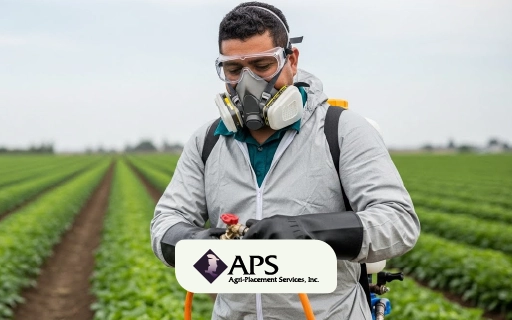
Using pesticides isn’t negotiable in order to guarantee crop protection and yield stability in U.S farms. Indeed, for the farmworker, obtaining a pesticide certification represents a significant sept up in skill, responsibility and earning potential. That’s why, for the employer and operational leader, ensuring their crew has the correct certification, or at least the mandatory training is an essential component for risking mitigation and having a good EPA license compliance.
With this article, we pretend to clarify the pathways for becoming a qualified handler or a formally certified applicator. We will also detail the difference between basic Worker Protection Standard (WPS) training and the formal process to get a pesticide applicators license, a legal requirement essential for handling high-risk chemicals and protecting the business from regulatory failure and understanding what is an EPA license.
Pesticide Certification
The term “pesticide certification” often sounds more complicated than it really is. In simple terms, the EPA, which means the Environmental Protection Agency, and each state, divides pesticide work into two clear categories. For the employer, understanding this crucial distinction is your first layer of protection during inspections, because one misunderstanding can lead to fines, delays, or failed audits. Therefore, these are the main distinctions.
The WPS Training
The Worker Protection Standard (WPS) is not discretionary; it is a federal mandate designed to protect employees from pesticide exposure on farms, forests, nurseries, and greenhouses. The process is that every worker and handler must receive this training on their first day of work and annually thereafter. The frequency of the WPS training is because it is the employer’s first defense against compliance risk and must be documented meticulously to satisfy DOL and EPA inspectors.
What does the WPS training cover?
Critical topics essential for worker safety and employer liability:
- The hazards of pesticides and routes of exposure.
- Protocols for minimizing exposure, including mandatory Personal Protective Equipment (PPE) rules.
- Emergency procedures, including rapid decontamination and first aid protocols.
- The meaning and strict enforcement of the Restricted Entry Interval (REI) signs and field notification requirements.
- The location and provision of decontamination supplies and emergency transportation.
Note: WPS training is essential for general workers, but it doesn’t authorize them to handle or apply Restricted-Use Pesticides (RUP). Relying solely on this training for RUP application exposes the operation to immediate federal fines.
To stay compliant and avoid costly EPA or state penalties, a Certified Applicator must be the one applying the product or must be immediately available to supervise and make all chemical-use decisions.
The Formal Path to Pesticide Certification: How to Get a Pesticide License
The process to get a pesticide license is overseen by the state’s regulatory body (usually the Department of Agriculture, Environmental Quality, or a similar agency). The two main categories of licensure dictate the scope of the applicator’s legal practice.
1. Private Applicator Certification (The Essential Farmworker’s License)
This is the most common and operationally essential certification for employees on farms that utilize Restricted Use Pesticides (RUPs).
Who Needs It: An individual who applies Restricted Use Pesticides (RUPs) to land owned, leased, or managed by themselves or their employer, for the purpose of producing an agricultural commodity. This is the primary license ensuring compliance on large commercial farms.
Process and requirements:
- Meet the Minimum Age and Language Requirements: Most states require the applicant to be at least 18 years old.
- While study materials may be available in Spanish, the exam is often administered in English, or requires a state-approved translator, adding a layer of logistical complexity.
- Acquire and Study the Training Manuals: This step is paramount. The applicant must obtain the relevant state-issued training manual, which covers core laws, environmental impact, and specific application techniques. These materials are typically distributed through the County Extension Office or the State Department of Agriculture.
- Pass the Exam: The applicant must pass a standardized state exam covering core concepts such as federal and state laws, safety, label interpretation, and basic agricultural categories. The rigor of this exam ensures the applicator understands the critical environmental and legal implications of RUP use.
- Licensure and Fees: Pay the required application and licensing fee (which varies significantly by state) for the Private Applicator Certification card.
Duration and Renewal: Licenses are typically valid for a fixed period (often 3 to 5 years). Renewal requires accumulating a set number of Continuing Education Units (CEUs), another compliance responsibility that the employer must track and fund to maintain a certified team.
How do you get a pest control license?
This license pertains to individuals who apply pesticides for hire, such as those working for a pest control company or an agricultural service contractor.
- Who Needs a pesticide control license: Anyone applying RUPs or general-use pesticides on the property of another person for compensation, or applying RUPs for purposes other than agricultural production (e.g., structural pest control, right-of-way management, public health).
- The Process to get it: The path is rigorous, requiring the applicant to pass the general Core Exam plus a specific Category Exam (e.g., Aerial, Ornamental & Turf, or Regulatory Pest Control). The requirements for liability insurance, bonding, and record-keeping are significantly stricter.
The Role of University Extension: A Resource for Farm Compliance
If you are a worker trying to get certified, or an employer trying to stay out of trouble with regulators, the University Extension System (Ohio State, Cornell, Nebraska, etc.) is one of your best resources.
Here is how they help:
- Training and study guides: Extension offices provide the official study manuals for the pesticide license exam and often offer classes or review sessions to help you pass.
- License renewal CEU: They also offer Continuing Education Units (CEUs) required for license renewal, ensuring that the certified applicator remains current with evolving EPA and state regulations.
- Practical guidance: Extension educators provide guidance on Integrated Pest Management (IPM), proper calibration, and application record-keeping, all essential elements that demonstrate due diligence and mitigate employer liability during a compliance audit.
Why Pesticide Certification Matters for ROI and Risk MitigationFor a farmworker, obtaining a pesticide applicators license offers immediate strategic value. For the employer, funding and supporting this process is a direct investment in operational efficiency and reduced regulatory exposure.

Conclusion: The Indispensable Investment in Compliance
For organizations relying on specialized labor, investing in the training and certification of key staff is not a variable expense, it is a mandatory investment in compliance stability and production throughput.
Relying on unlicensed personnel for restricted applications is a gamble that no serious agribusiness operator can afford.
The simplest way to understand “what is an EPA license?” in agriculture is this: it’s the certification required to apply certain pesticides safely and legally. This credential, known as the Certified Applicator license, is what protects your farm when using Restricted Use Pesticides (RUPs).
Making sure your applicators are properly licensed is one of the strongest safeguards you have against costly mistakes. Therefore, in Agriplacement (APS) we provide specialized labor solutions that prioritize compliance from day one. We integrate WPS training and certification support into our operational models, ensuring that your workforce is not just present, but fully compliant and legally qualified to protect your yields.
Partner with APS to convert your regulatory burden into an operational advantage. Secure your yields. Eliminate your liability.