As the country’s top producer of ornamental plants, tropical foliage, and young fruit trees, the plant nursery sector carries huge value but also huge risk. Nurseries don’t just lose money when labor is unstable—they risk losing entire inventories to pests, disease, failed inspections, or the loss of state certification.
Unlike row-crop farming, where instability primarily risks yield loss, a labor gap in a nursery can destroy millions in live plants within days. That’s why a steady, skilled workforce translates to operational survival and stable profits.
This article is a guide for business owners and workers who need to know the skills required for plant nursery jobs, how H-2A visa sponsorship really works, and what it costs to secure a reliable crew. As an HR company, we know understanding these pieces is essential for protecting your inventory and keeping your operation profitable year after year.
I. What it Takes to Get a Plant Nursery Work: Profile and Skillset
The role of the plant nursery worker is strategic, as these individuals are the daily custodians of the high-value biological assets for crops.
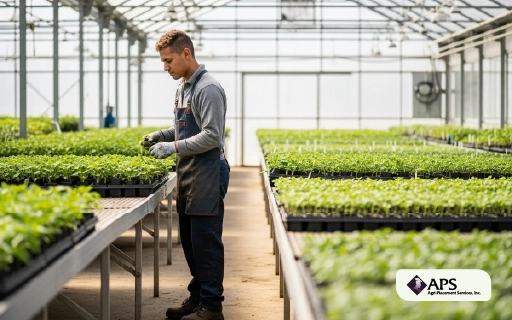
Besides performing a comprehensive management of crops in containers or open fields, the job involves constant monitoring that goes beyond watering. It is directly impacting the quality, uniform growth, and commercial viability of the plants.
A. Skills
The principal objective of these skills is the minimization of losses and acceleration of the commercialization process.
- Phytosanitary Vision as Risk Mitigation: This is the most valuable ability. The worker must be capable of identifying the early symptoms of water stress, nutritional deficiencies, or the premature presence of pests and diseases. Rapid detection allows for treatment before quarantine is required or the issue spreads to the rest of the inventory.
- Manual Skill and Precision: Tasks like pruning, transplanting, and propagation (grafting or cuttings) are manual and require precision to ensure the survival and aesthetic form of the plant, which is directly linked to its resale value. The perfection of this skill takes time and experience, but with the right training you can achieve it.
- Basic Equipment Handling: Includes the safe operation of forklifts, water pumps, high-pressure hoses, and, occasionally, basic equipment for fertilization or chemical mixing.
B. Education and Experience
Unlike some other technical roles, practical experience in plant nursery jobs is often valued more than formal education for initial positions:
- Formal Education: University degrees are generally not required. Instead, practical experience with different crop types and weather conditions is the priority.
- Internal Training: The employer must provide specific training on chemical safety (Worker Protection Standard – WPS) and pest control protocols approved by the state of Florida.
- Added Value: The ability to speak English is a plus for communication with supervisors, but fluency in Spanish is crucial for team collaboration, given the demographic profile of Florida’s agricultural workforce.
At Agriplacement, we have a plus in providing cultural support to employers and employees such as oral translation services as needed, written translations of operation procedures as agreed, and assistance to facilitate employee’s acclimation to the local community and other cultural amenities. This plus is very important for a good experience as a foreign plant nursery worker.
II. Salaries and Regulation
For operational leaders, the most critical element of staffing plant nursery jobs is not the raw hourly wage, but the total cost dictated by federal and state regulations. Florida’s high volume of specialty crops makes it a focal point for Department of Labor (DOL) audits.
A. The Adverse Effect Wage Rate (AEWR) Mandate
For compliance audits by the Department of Labor, the AEWR is the government-mandated floor for all agricultural positions filled through H-2A visa sponsorship, including plant nursery workers. This rate is determined annually by region, and its importance is to regulate salaries across all states.
- How does it work in Florida: Employers of H-2A workers in Florida must pay whichever is highest: the federal minimum wage, the state minimum wage, or the regional AEWR. Historically, the AEWR is significantly higher than Florida’s state minimum, making it the effective wage floor for compliance.
- Audit Exposure: Failing to meet the AEWR may result from an accidental error or an outdated rate. This is because it constitutes a federal violation, exposing the nursery to back-pay demands, crippling fines, and future labor certification denial.
B. Indirect Costs and Compliance Burdens
The hourly wage itself is only a fraction of the total operational expense of securing labor through H-2A. The bigger expenses come from the rules employers must follow. These hidden costs hit a nursery budget much harder than the paycheck itself. Here’s the reason why:
- Housing and Transportation: Under DOL regulations, the employer must provide clean, approved housing and free daily transportation to and from the job site. This isn’t optional, and both are subject to inspections. For most nurseries, this becomes one of the largest non-wage costs.
- Recruitment Proof: Before getting the H-2A approval, the employer must prove that U.S. workers were unavailable by conducting rigorous and documented domestic recruitment efforts.
- Chemical Safety Compliance: Nursery workers often handle pesticides and other chemicals. Therefore, federal law requires formal documented training under the Worker Protection Standard (WPS). This takes time, money, and creates additional compliance responsibility for the employer.
C. Strategic Takeaway for Employers
The economic pressure created by the AEWR, combined with mandatory housing, transportation, and strict compliance requirements, means that only the most efficient and low-turnover nursery operations can manage H-2A labor profitably.
In order to make this investment worthwhile, nurseries must secure a workforce capable of meeting high productivity standards while minimizing risk. This makes partnering with a specialized firm essential for managing the complexity and ensuring you bring in workers who justify the cost.
Agriplacement (APS) turns this complexity into operational stability. We provide the specialized HR expertise and compliance management needed to secure a reliable, high-performing workforce for your nursery. Partner with us and build a workforce you can rely on.
III. Conclusion: The Strategic Imperative for Florida Nursery Operations
The conversation around plant nursery jobs in Florida is ultimately a strategic discussion about protecting high-value inventory from two primary threats: biological risk and regulatory risk. The decision to staff an operation, whether through domestic workers or through H-2A visa sponsorship, directly determines how effectively you can manage those threats while remaining profitable.
As established, a labor shortage or high turnover means more than just slow growth; it means an increase in the likelihood of missing early signs of pests or disease. When these issues go unnoticed, the result is not simply an operational mistake, it is a financial disaster. It can lead to entire blocks of ornamental stock placed under quarantine, rejected, or destroyed, eroding millions in capital investment.
A stable, trained workforce is therefore more than a labor expense; it is your first line of protection against catastrophic biological loss.
The strategic takeaway for the Florida nursery owner is clear: long-term stability will not come from short-term hiring fixes. It requires a dedicated, specialized partner capable of managing the entire labor lifecycle—from recruitment in the home country to Worker Protection Standard (WPS) compliance and day-to-day crew management.

The Smartest Decision You Can Make This Season
You know how to grow plants. APS knows how to protect the workforce behind them.
Don’t let the maze of DOL compliance, AEWR wages, housing inspections, and H-2A regulations put your high-value nursery inventory at risk. Florida’s nursery sector demands absolute labor stability; one gap in staffing or one compliance error can cost you entire blocks of product.
Agriplacement (APS) steps in as the operational shield your nursery needs.
We manage the full H-2A process — recruitment, onboarding, documentation, compliance, transportation, and Worker Protection Standard (WPS) training. Our crews arrive ready, reliable, and fully aligned with your phytosanitary and production standards.
- Protect your plants
- Protect your certification
- Protect your bottom line
Turn your biggest workforce vulnerability into your most dependable advantage.
Contact APS today and secure the stable labor force your operation needs to thrive all season long.